Is having Photoshop skills essential for web developers in 2026
Highly opinionated blog post about the need for having different skills
Six years ago I wrote about how learning Photoshop, back when I had way too much free time in China, accidentally taught me how to think in CSS. Layers, absolute positioning, the "onion" mental model — it all transferred.
I said Photoshop wasn't required, but understanding it helped. That's still true. What's changed is how much CSS has caught up, and what replaced Photoshop as the "extra skill that helps."
Here's the update.
The shadow trick I struggled with for weeks? It's one line now.
In the original article, I spent a good chunk of it explaining how my coding partner and I couldn't reproduce a soft animated shadow under an image using pure CSS — how we eventually solved it by taking another element, rotating it on the X-axis, blurring it, and stacking it underneath. Basically simulating a Photoshop drop shadow layer by hand with absolute positioning.
In 2026, that's:
css
filter: drop-shadow(0 20px 20px rgba(0,0,0,0.3));One property. No extra element, no rotation hack, no fighting with ::before/::after defaulting to display: inline.
Honestly, this is a better proof of my original point than the original example was. The Photoshop-to-CSS gap I said was "closing fast" in 2020 — it closed. What took a rendered element, a transform, and a blur filter is now a native CSS primitive that does exactly what the Photoshop layer panel does.
CSS itself thinks more like Photoshop now
A few things that didn't exist (or weren't usable) in 2020 that make the layers analogy even stronger:
:has()— parent elements reacting to their children, closer to how a Photoshop group can be conditionally styled based on what's inside it.Container queries — an element responding to its own box rather than the viewport. This is much closer to how a Photoshop smart object behaves than anything media queries ever gave us.
color-mix()— blending two colors natively, which maps directly to picking blend colors in the color picker instead of computing hex math by hand.Native CSS nesting — closer to how layers live inside folders inside folders.
If the 2020 version of me was translating "how would I do this in Photoshop" into CSS, the 2026 version of that exercise is faster and more literal.
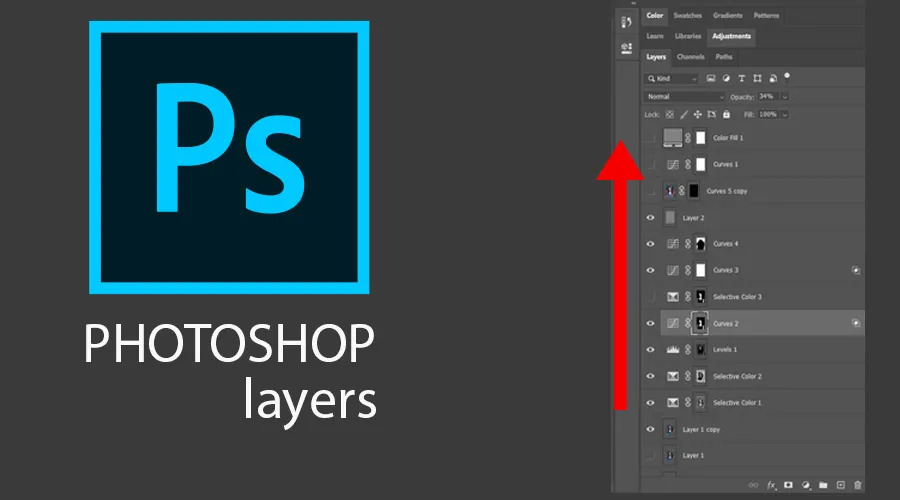
Figma didn't just win; it absorbed the whole workflow
In 2020 I said, "everyone's using Figma anyway, which resembles Photoshop." That was true, but Figma has since added Dev Mode, code export, and AI-assisted layout — meaning the designer-to-developer handoff I described (needing to open a PSD, pick colors with a color picker, avoid miscommunication) barely exists as a problem anymore. If your company still hands you a flattened PSD in 2026, that's the exception, not the workflow.
So the honest update to my "no, but nice to have" stance: it's now closer to just no. The reason to know Photoshop today isn't cross-team communication — it's the same reason I originally learned it: because understanding layers, blending, and composition makes you think spatially, and that's still a useful skill for any front-end work, regardless of which tool teaches it to you.
But one more thing is haunting me: if machines become so much more intelligent, what will we still need to use our own intelligence for? Because if man does not use something, it atrophies
The new version of "learn Photoshop to learn CSS" is AI generating the CSS for you
Here's the part that didn't exist in 2020 at all: tools that take a screenshot or a text description and generate the layout and CSS directly. That's functionally the same translation I was doing by hand — "here's the visual, here's the code that produces it" — except a model does the translation now instead of a developer squinting at a Photoshop file.
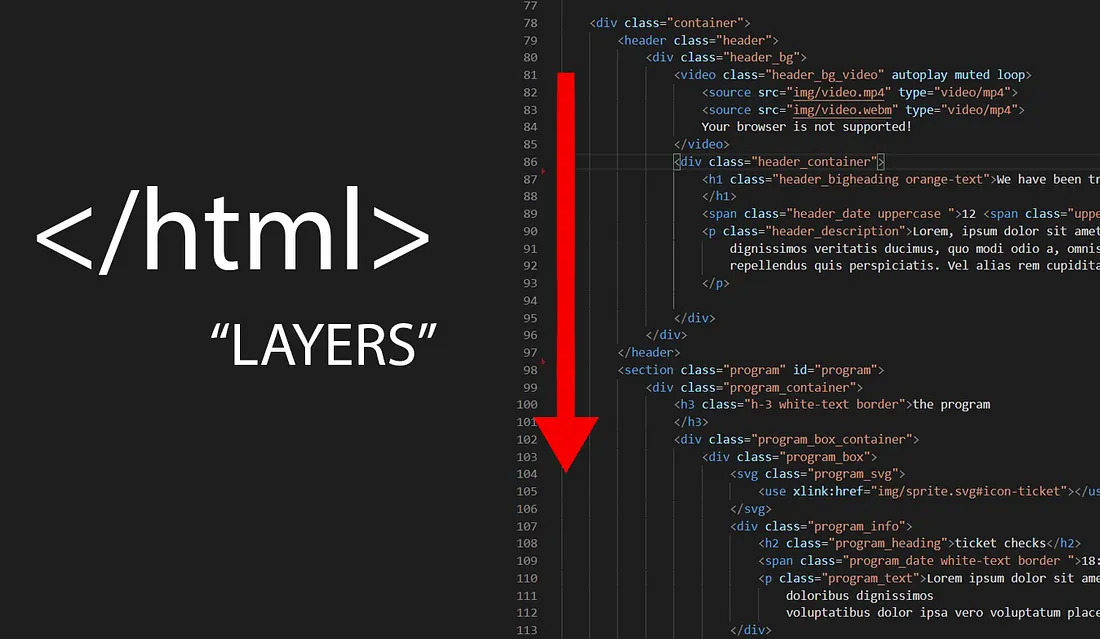
I don't think this makes the underlying skill useless. If you don't understand why a drop shadow needs a blur radius and an offset, you can't fix it when the generated code is 80% right and the last 20% needs a human. The layers-first mental model I built by accident in 2009 is still exactly what lets me tell whether AI-generated CSS is doing the right thing or just looking right in one screenshot.
And the copyright question got weirder, not simpler
Back then my solve to the stock-photo copyright anxiety was simple: use my own photos. That still holds — and it's why the visuals in the original 2020 post are still fine to reuse, they're mine. But the industry's version of that problem has shifted from "can I use this photographer's image" to "who owns an AI-generated image, and was it trained on someone else's work without consent." I don't have a tidy answer for that one. I'd rather keep taking my own photos than find out the hard way.
So, still relevant in 2026?
Not as a required skill — that part of my 2020 answer hasn't changed. But the actual lesson buried in the article — that understanding visual composition (layers, stacking, blending, spatial relationships) makes you a better CSS developer regardless of which tool taught it to you — got more relevant, not less. It's the same skill that now lets me sanity-check AI-generated layouts instead of just eyeballing them.
Six years later, my main regret isn't the time I spent in Photoshop, Illustrator, Flash, After Effects, or (extremely unnecessarily) ZBrush. It's that it took me this long to notice the shadow trick had a one-line solution the whole time.
Published July 31, 2026
← All Posts